
.jpg)




EXPOSICOES
o que ja passou por aqui
A noite não adormece nos olhos das mulheres
No mundo antigo, as mulheres eram submetidas a uma camada intensa de interpretações masculinas; seus corpos, seus desejos e sua natureza eram delimitados como uma poluição que deveria ser contida nos espaços públicos e sagrados. Anne Carson, em seu estudo sobre a fenomenologia da poluição feminina, nos conta que a civilização é resultante das fronteiras, dos limites. Portanto, era necessário ilhar a mulher, isolá-la da sociedade e de si mesma. Essa é, comprovadamente, a estratégia por trás de muitas noções, convenções e rituais que circundavam a vida feminina no mundo antigo. Mulheres foram definidas como seres molhados, detentoras de vazamentos, companheiras da deformação. A mulher incha, encolhe, vaza, é penetrada, fica ereta e sofre metamorfoses. Todo esse líquido aguado de sangue, lágrimas, suor e gozo era entendido como uma sujeira contagiosa e que necessitava da exclusão.
O que pode o feminino tocar quando seus desejos são narrados como armadilhas de lascívia e sua liberdade é tida como uma profanação ao mundo dos homens? A corporalidade do feminino vem se estilhaçando cada vez mais, se modificando, deformando, metamorfoseando, sendo sua matéria de afirmação: uma rede de inundadas fugas. Nessa ontologia aquática, lustrosa, lacrimejante e perplexa de sujos resíduos, novos desejos e anseios vem tomando forma, enredados por enunciações de novos mitos em fabulação.
Em ''A noite não adormece nos olhos das mulheres'' — trecho retirado do poema de Conceição Evaristo dedicado à pensadora Beatriz Nascimento, convidamos artistas para discutir sobre sujeiras, águas, desejos e mitos. A exposição se apresenta como um arquipélago noturno, regido por sombras, cobras, escombros e margens. Cada ilha vislumbra o seu mergulho na boca da noite e nela se encharca em anseios próprios. É nessa busca por uma singularidade diversificada e expansiva que cada trabalho apresenta para o coletivo o seu caráter imaterial de desejar suas próprias transmutações.
“Me fiz máscara, mulher e conjetura’’, Hilda Hilst em ‘’Da noite’’, (1992)
A noite é a parideira de velhas e novas cosmologias; nela se escondem os mistérios habitados nos mares escuros e nos solos em maturação. A noite é a eterna evocadora das liberdades, dos desejos, dos amantes e das criaturas oníricas que, despertadas, encontram em seu dorso uma uníssona sinfonia. É em seu tempo lunar que o feminino transmuta os sonhos e se forma em novas materialidades. Amara Moira em escritos sobre ''As malditas'' de Camila Sosa Villada, trama um anúncio: ''Travestis personificam o sonho: se elas existem, tudo é possível'', mas esse anúncio também ecoou anteriormente da boca de Luana Muniz, chamada de filha da lua, ela nos mostra a engenharia da travestilidade: ''A travesti é uma fábrica de sonhos, ela mesma não pode acreditar nos sonhos que fabrica, ainda é um dos poucos recantos onde o ser humano pode sonhar.''
Nesses despertares de vivendas noturnas, o feminino pode ser descompassado e surgir dentro de outras. Nesse sinuoso caminho dos confinamentos da feminilidade, as simbioses de corporalidades outras se apresentam como a verdadeira liberdade executada na desconstrução de ideários totalitários de gênero. O ser do feminino não é espírito de generalizações absolutas; ele deve ser gerido em partes diferentes de um todo, ou seja, validar toda fecundação particular, dar a todas/es as possibilidades de se poder encontrar nela, habitar ela, coletivamente ou de forma solitária.
Nesses orifícios abertos em discussão pela curadoria, os trabalhos se apresentam por sua diversidade de pesquisas e intenções. A noite atua como uma encruzilhada do mistério que eclode das escuridões, gerando seres outros que buscam emergir em suas próprias origens. A artista Luiza Lukah apresenta uma pintura inspirada em seres abissais: a tigresa, como figura central, aparece rompendo a concha que a envolve; nesse movimento, o animal deixa de ser parte do abismo e passa a gerar uma luz própria que envolve e ilumina seu redor. Ainda pensando nas cintilâncias que brotam em matérias noturnas, Natha Calhova propõe uma terra negra que habita o chão do espaço expositivo; esses pequenos punhadinhos de noite são habitados por glitter, massinhas de modelar, pasta de dente, miçangas e outras materialidades. As intervenções nos convidam ao agacho, buscando entender essas materialidades que se fabricam e deixam rastros em contato com a terra preta e úmida. Em Céu Isatto, somos expostas às pinturas-instalação ''Adoçar a terra encharcar a terra afogar a terra'' e ''Fogo-fátuo'', trabalhos que habitam as limiaridades entre o figurativo e o abstrato, transparência e opacidade, fato e ficção, vigília e sonho, dicotomias que são movidas pelo desacato das interpretações fechadas.
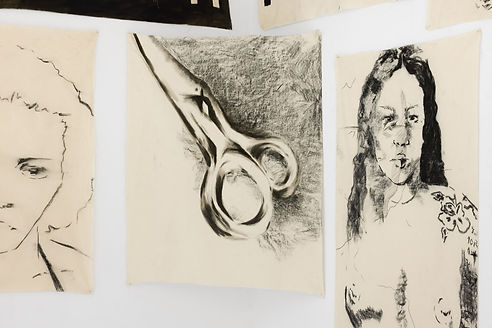
A travestilidade foi e ainda é evidenciada como uma identidade pertencida à noite, ao sigilo, ao oculto. Gi Monteiro e Madu Peruzzo apresentam trabalhos que reorganizam essas óticas, nos quais retiram as definições atribuídas pela cisgeneridade e propõem novas formas pelas quais corpos dissidentes reelaboram esses imaginários. Monteiro apresenta "Trombeta de Anjo", pintura em tecido escuro, ornamentada com palha, na qual trata do escuro como uma pronúncia de liberdades e da manutenção das memórias ancestrais. Madu propõe uma revisão dos preceitos direcionados a corpos trans, na série ''Pau Brazyl'' — maior trabalho em dimensão da exposição, é construída de forma rústica em algodão cru e produzida em nanquim e carvão, deixando explícito as práticas intensas de esfregação dos desenhos. As dez telas expostas são registros iconográficos de estudos da corporalidade travesti, imagens de partes do corpo aproximadas, o retrato da artista, uma releitura da figura de Vênus, o retrato de Dandara, travesti brutalmente assassinada em Fortaleza, e as palavras ''Travesti'' e ''Fodida''. Peruzzo nos convoca a sermos abocanhadas pela dimensão e a encararmos as imagens e seus tensionamentos.
"Como Invocar Uma Deusa", parte da série Sigilos de Thiá Sguoti, apresenta na exposição uma escultura moldada em ferro e folheada com ouro, representando um símbolo que era utilizado para invocar divindades em rituais pagãos. Presentes em diversas religiões pagãs, os sigilos são selos gráficos associados a uma entidade espiritual. Esta estrutura abstrata, composta por linhas, curvas e traços geométricos, representa Vepar, uma divindade da demonologia ocidental medieval, entendida como uma sereia.
Em "Do rio das cobras", Tais Koshino constrói um políptico composto por seis telas cobertas com pigmento coletado no Rio das Cobras (Chapada dos Veadeiros, Goiás). A pintura instiga a pensar em cartografias das marcas do fluxo das águas do rio e suas margens. Koshino também apresenta outras duas pinturas que atravessam as ideias envoltas pelas águas, dessa vez, utilizando-se da ficção especulativa para narrar correntes migratórias e a relação estabelecida entre humanos e águas. A série revisita a teoria de Rokurō Kōyama, pioneiro da imigração japonesa no Brasil, como uma ficção etnográfica. A partir de um estudo etimológico que desenvolve, Kōyama propõe um parentesco entre as línguas tupi e japonesa, sugerindo uma origem comum desses povos, vinda das ilhas do Oceano Pacífico. A partir da hipótese de uma língua proto-tupi-japonesa e da ideia de uma origem comum entre japoneses e povos indígenas brasileiros, a série apresenta imagens desse povo ancestral em pinturas que trazem cenas de corpos em relação com o oceano e paisagens, nas quais os limites entre céu, mar e corpo se tornam difusos.
Barbara Banida compõe o espaço expositivo com dois trabalhos oriundos, de 'Erotar' — planeta criado como ecologia especulativa, para que corpos em contranorma habitem e floresçam. Banida nos provoca a elaborar juntes outras possibilidades de ecoamentos existenciais no mundo. É através de uma ficção atenta ao ecológico que podemos nos manter vives e criando comunidades, seres, espaços, espiritualidades, esperanças que fogem ao que até hoje foi delimitado usualmente para benefício de poucos.
''Desejo é um todo lustroso de carícias, uma boca sem forma, um caracol de fogo.'' Hilda Hilst, ''Do desejo'' (1992)
''Língua Caracol'' e ''Bocarra'', trabalhos de Gio Soifer, que se organizam através da pergunta ''O que pode uma boca quando não está a serviço da palavra?''. A língua-caracol nos escapa, escorre por rastros de viscosidade em superfícies diversas, aliada à presença da concha, pode gerar estímulos sensoriais que aludem ao erótico e ao ato de lambeção. Em contraponto às alusões sensoriais molhadas, Bocarra traz um incômodo de maneira mais agressiva, por conta de sua materialidade seca. O trabalho, que em primeiro contato pode ser identificado como a ilustração do orifício da boca e dos dentes, nos convida para um giro em sua volta, entendendo seus espinhos que estão apontados para o seu interior e exterior, assim como a essência do desejo. O trabalho se apresenta como explanação de fronteiras entre prazer e dor, aproximação e distanciamento, perigo e conforto.
Ainda em elaborações fronteiriças, Nina Horikawa e Amanda Fahur apresentam trabalhos que se tomam pelas ideias de limite, divisa, labirinto, baliza, separação e extremidade. Fahur constrói uma pintura labiríntica, cheia de canais que se movimentam para todo lado, como canais de rios que se abrem. Ao se aproximar da obra, podemos ver as espumas em suas margens. Horikawa, de forma figurativa, traz um retrato aproximado; a figura, que está de olhos fechados, aparenta estar em um mergulho interno ou em sono profundo.
Nazas tem uma pesquisa que se articula no tecnobrega e o desejo amoroso é brega, o ser romântico é marcado pelo desespero de querer a presença constante do ser amado e que em sua ausência se encontra em molhadas lembranças. É também nessa estrutura dicotômica entre querer a presença e, ao mesmo tempo, o esquecimento, pela ideia de possível alívio do coração. O desejo amoroso é labirinto, fronteira, extremidade que não é habitante nem aliado à pessoa desejante, alheia a ela, de fora; o desejo se impõe, irresistível.
Gui Zrenner, curadoria do projeto Mulheres Arquivadas
The night does not fall asleep in women’s eyes
In the ancient world, women were subjected to a thick layer of male interpretations; their bodies, desires, and nature were defined as a form of pollution that had to be contained within public and sacred spaces. Anne Carson, in her study on the phenomenology of female pollution, tells us that civilization is the product of boundaries and limits. Thus, it was necessary to island the woman, to isolate her from society and from herself. This is, demonstrably, the strategy behind many of the notions, conventions, and rituals that shaped women's lives in the ancient world. Women were defined as "wet" beings, prone to leaking, companions to deformity. A woman swells, shrinks, leaks, is penetrated, becomes erect, and undergoes metamorphoses. All these watery fluids, blood, tears, sweat, and sexual release were understood as contagious filth requiring exclusion.
What can the feminine touch when its desires are narrated as traps of lust and its freedom is deemed a profanation of the world of men? Female corporeality has been increasingly shattering, shifting, deforming, and metamorphosing, finding its substance in a web of flooded escapes. Within this aquatic, lustrous, tear-streaked ontology, perplexed by unclean residues, new desires and yearnings are taking shape, entangled in the articulation of new, unfolding myths.
In "The night does not fall asleep in women’s eyes" — a line taken from a poem by Conceição Evaristo dedicated to the thinker Beatriz Nascimento, we invite artists to discuss filth, water, desire, and myth. The exhibition presents itself as a nocturnal archipelago governed by shadows, snakes, rubble, and margins. Each island envisions its own plunge into the mouth of the night, soaking itself in its own unique yearnings. It is in this pursuit of a diverse and expansive singularity that each work presents to the collective its immaterial character of desire for its own transmutations.
“I made myself a mask, a woman, and a conjecture,” Hilda Hilst in “Da noite” (1992)
Night is the midwife of old and new cosmologies; within it hide mysteries dwelling in dark seas and maturing soils. Night is the eternal summoner of freedoms, desires, lovers, and dreamlike creatures that, upon waking, find a unison symphony across its expanse. It is during its lunar time that the feminine transmutes dreams and takes shape in new materialities. In her writings on Camila Sosa Villada’s “As malditas” (The Cursed Ones), Amara Moira weaves a proclamation: “Trans women embody the dream: if they exist, anything is possible”, but this proclamation had already echoed from the lips of Luana Muniz, known as a daughter of the moon, she reveals to us the engineering of travestilidade: “The travesti is a dream factory, she herself may not believe in the dreams she manufactures, yet it remains one of the few sanctuaries where a human being can dream.”
In these nocturnal awakenings, the feminine may move out of step, emerging within other forms. Along this winding path through the confines of femininity, the symbioses of alternative corporealities present themselves as true freedom enacted through the deconstruction of totalitarian gender ideologies. The essence of the feminine is not a spirit of absolute generalizations; it must be cultivated across the distinct parts of a whole, validating every unique act of creation and offering everyone the possibility of finding themselves within it, of inhabiting it, whether collectively or in solitude.
Within these openings brought into discussion by the curatorship, the works present themselves through the diversity of their research and intentions. The night acts as a crossroads of the mystery that erupts from the darkness, generating other beings that seek to emerge from their own origins. Artist Luiza Lukah presents a painting inspired by abyssal beings: the tigress, as the central figure, appears breaking through the shell that surrounds her; in this movement, the animal ceases to be part of the abyss and begins to generate a light of its own that envelops and illuminates its surroundings. Still thinking about the scintillations that spring from nocturnal matters, Natha Calhova proposes a black earth that inhabits the floor of the exhibition space; these small handfuls of night are inhabited by glitter, modeling clay, toothpaste, beads, and other materialities. The interventions invite us to crouch down, seeking to understand these materialities that fabricate themselves and leave traces in contact with the black, damp earth. In Céu Isatto, we are exposed to the painting-installations ''Adoçar a terra encharcar a terra afogar a terra'' and ''Fogo-fátuo'', works that inhabit the thresholds between the figurative and the abstract, transparency and opacity, fact and fiction, wakefulness and dream, dichotomies that are set in motion by the defiance of closed interpretations.
Travestility was, and still is, marked as an identity belonging to the night, to secrecy, to the hidden. Gi Monteiro and Madu Peruzzo present works that reorganize these perspectives, in which they remove the definitions assigned by cisgenderness and propose new ways through which dissident bodies rework these imaginaries. Monteiro presents “Trombeta de Anjo”, a painting on dark fabric, ornamented with straw, in which she addresses darkness as an utterance of freedoms and of the maintenance of ancestral memories. Madu proposes a revision of the precepts directed at trans bodies in the series “Pau Brazyl”—the largest work in the exhibition in terms of scale, it is constructed in a rustic manner with raw cotton and produced with India ink and charcoal, making explicit the intense rubbing practices through which the drawings were made. The ten canvases on view are iconographic records of studies of travesti corporeality: close-up images of body parts, the artist's portrait, a reinterpretation of the figure of Venus, the portrait of Dandara, a travesti brutally murdered in Fortaleza, and the words Travesti and Fucked. Peruzzo calls on us to be swallowed by its scale and to confront the images and their tensions.
How to Invoke a Goddess, part of Thiá Sguoti's Sigils series, presents in the exhibition a sculpture cast in iron and gilded with gold leaf, representing a symbol that was used to invoke deities in pagan rituals. Present in various pagan religions, sigils are graphic seals associated with a spiritual entity. This abstract structure, composed of lines, curves, and geometric strokes, represents Vepar, a deity from medieval Western demonology, understood as a mermaid.
In “Do rio das cobras”, Tais Koshino constructs a polyptych composed of six canvases covered with pigment collected from the River of Snakes (Chapada dos Veadeiros, Goiás). The painting prompts us to think about cartographies of the marks left by the river's flow and its banks. Koshino also presents two other paintings that move through ideas enveloped by water, this time making use of speculative fiction to narrate migratory currents and the relationship established between humans and water. The series revisits the theory of Rokurō Kōyama, a pioneer of Japanese immigration to Brazil, as an ethnographic fiction. From an etymological study he develops, Kōyama proposes a kinship between the Tupi and Japanese languages, suggesting a common origin for these peoples, coming from the islands of the Pacific Ocean. Based on the hypothesis of a proto-Tupi-Japanese language and the idea of a common origin between Japanese people and Indigenous Brazilian peoples, the series presents images of this ancestral people in paintings depicting scenes of bodies in relation to the ocean and landscapes, in which the boundaries between sky, sea, and body become diffuse.
Barbara Banida composes the exhibition space with two works originating from Erotar—a planet created as a speculative ecology, so that counter-normative bodies may inhabit and flourish. Banida encourages us to collectively elaborate other possibilities of existential reverberations in the world. It is through a fiction attentive to the ecological that we can remain alive and creating communities, beings, spaces, spiritualities, hopes that escape what has until now usually been delimited for the benefit of a few.
"Desire is a lustrous whole of caresses, a mouth without form, a snail of fire." Hilda Hilst, On Desire (1992)
"Língua Caracol" and "Bocarra", works by Gio Soifer, are organized around the question, "What can a mouth do when it is not in the service of the word?" The snail-tongue escapes us, running through trails of viscosity across different surfaces; together with the presence of the shell, it may generate sensory stimuli that allude to the erotic and to the act of licking. In contrast to these wet sensory allusions, Big Mouth brings forth a discomfort in a more aaggressive way, due to its dry materiality. The work, which at first glance may be identified as an illustration of the mouth's opening and its teeth, invites us to move around it, understanding the thorns that point both inward and outward, as does the essence of desire. The work presents itself as an exposition of the boundaries between pleasure and pain, closeness and distance, danger and comfort.
Still within these elaborations on boundaries, Nina Horikawa and Amanda Fahur present works that take up ideas of limit, border, labyrinth, marker, separation, and extremity. Fahur constructs a labyrinthine painting, full of channels that move in every direction, like river channels opening up. As we approach the work, we can see the foam along its edges. Horikawa, in a figurative manner, presents a close-up portrait; the figure, with closed eyes, appears to be immersed in an inward dive or in a deep sleep.
Nazas has a practice articulated through tecnobrega, and amorous desire is brega; the romantic being is marked by the desperation of wanting the constant presence of the beloved, and, in their absence, finds themself among soaked memories. It is also within this dichotomous structure between wanting that presence and, at the same time, forgetting it, through the idea of a possible relief for the heart. Amorous desire is a labyrinth, a border, an extremity that is neither an inhabitant nor an ally of the desiring person, but something outside them, foreign to them; desire imposes itself, irresistible.
Gui Zrenner, curator of the Mulheres Arquivadas project