
Aun Helden
EYIBRA
Lau Mota
Raphael Tepedino



EXPOSICOES
o que ja passou por aqui
Músculo
Proponho uma atenção ao músculo que se contrai, ao músculo doente, ao músculo que performa o sonho de ver o corpo se deslocar. A performance, para além da experiência hiperconsciente da própria arquitetura corporal, também é a vontade de desmantelar o entorno e provocar uma fricção na realidade, como um tronco de árvore que se rebela contra o concreto de uma calçada, destruindo seu próprio funeral.
Como posso explicar que a distrofia da verdade é fundamental para que a paisagem se renda à ficção? Na maioria das vezes, há quase nenhuma palavra sendo dita; é como se o ato desejasse que você visse com outra atenção a imagem pegar fogo e a iconoclastia não apenas como um ato rebelde da falência do signo, mas como um meio de construir um novo mundo sem o dogma da salvação.
Muitas vezes, o desejo é frustrado, mas o esforço humano da tentativa torna a insurgência menos passiva. As novas espécies são criadas na tentativa de redigir o verbo que se escreve cíclico e vibrativo, como uma ode à impermanência e à decomposição.
Há uma obsessão pela turbulência de adentrar a liberdade onde a taxinomia violenta não existe e conseguimos abandonar o significado tradicional da ficção que é o tempo. A presença radical talvez seja fruto da dramaturgia da extinção, do gesto do rumor de que tudo vai acabar em breve, e a eterna sagração da primavera é dançada por ventres quentes e atonais que se reconhecem nos torsos esculpidos por uma nova geração.
A decisão de performar é um ato consciente, mas fantasioso. E não se engane: se pensa que a fantasia é aliada da mentira, mas um relicário para perfurar a realidade inexorável onde se rege o imaginário social. E nela dançamos atravessados pelo exercício da forma, observando a osmose e a aporia da mancha na parede, contradizendo as linguagens semelhantes às forças fictícias e inerciais da Física que centrifugam como um fenômeno abocanhando a história e o chão, sem obediência alguma à ideia frágil do que significa ser um corpo na miséria do teatro humano.
Aun Helden
Muscle
I propose an attention to the muscle that contracts, the diseased muscle, the muscle that performs the dream of seeing the body move. Performance, beyond the hyperconscious experience of one's own bodily architecture, is also the desire to dismantle its surroundings and create friction with reality, like the trunk of a tree rebelling against the concrete of a sidewalk, destroying its own funeral.
How can I explain that the dystrophy of truth is essential for the landscape to surrender to fiction? Most of the time, almost no words are spoken; it is as though the act itself wished you to look with a different kind of attention as the image catches fire, and to understand iconoclasm not merely as a rebellious act born from the collapse of the sign, but as a way of building a new world free from the dogma of salvation.
More often than not, desire is frustrated, but the human effort of trying makes insurgency less passive. New species are created in the attempt to write a verb that inscribes itself cyclically and vibrationally, like an ode to impermanence and decomposition.
There is an obsession with the turbulence of entering a freedom where violent taxonomy does not exist, where we can abandon the traditional meaning of fiction, which is time. Radical presence may be the result of the dramaturgy of extinction, of the gesture born from the rumor that everything will soon come to an end, while the eternal consecration of spring is danced by warm, atonal bodies that recognize themselves in the torsos sculpted by a new generation.
The decision to perform is a conscious act, yet an imagined one. And make no mistake: fantasy is not an ally of falsehood, but a reliquary through which to pierce an inexorable reality governed by the social imaginary. Within it, we dance, traversed by the exercise of form, observing the osmosis and the aporia of the stain on the wall, contradicting languages akin to the fictitious and inertial forces of physics that spin like a phenomenon swallowing history and the ground beneath it, without yielding to the fragile idea of what it means to be a body within the misery of human theater.
Aun Helden


E para nós, resta pêlo e ossos
Dentro de nós, sucata.
Pensemos performances como ações de um corpo. E o corpo deve estar ali. O que o corpo também deve é uma infinidade de coisas. Associamos movimento e estática à performance dentro da arte contemporânea, e o corpo deseja apresentar algo, representar algo, mostrar, apontar e contar. O que o corpo deseja também é uma infinidade de coisas.
Nosso corpo, que é uma máquina insistente, consegue nos mostrar muito com seus mecanismos programados e funcionamento obsessivo, que se desdobram e desdobram até se dissolver em um lugar que leio como imaterial, o lugar da não visão.
Os pensamentos que cabem nesse campo são quase metafísicos: O sentimento mora - fisiológico - dentro de nós? Onde se aloja o desejo? O cansaço? São sistêmicos ou estão acumulados em alguma junta? O espírito do corpo está dentro, agarrado aos órgãos, à direita do ventrículo esquerdo, ou se pendura invisível nas asas de nossos ombros?
Como gestora e fundadora do Projeto Caroço, há três anos tento me associar com artistas e curadores que traduzam essa fome de um estômago sem fundo que sinto ao comer do prato (as sobras) da arte contemporânea brasileira. Escrevo sempre que posso, mesmo que nunca deva, e organizo minhas observações sobre o que nos propomos como programa de um projeto que dá passos lentos e curiosos dentro de um mercado que já sabe bem o que quer.
A exposição que ocupa o espaço em Março, AAATRIOOO, intenciona já em seu título a primeira repetição visual - a da vogal - insistente e contagiosa como um bocejo, para nos convidar a comparecer à uma noite onde acontecem quatro performances duracionais dentro do espaço da galeria - cada uma com o tempo de quatro horas - simultaneamente acontecendo, duas em cada andar. A proposta, vinda de uma conversa entre a artista Aún Helden e eu, têm a intenção de criar um espaço passivo ao acontecimento performático, que chega aos olhos dos espectadores como sangue no átrio do miocárdio, e distribui aos sentidos humanos experiências que vão desde a interação física, como na performance de EYIBRA, que pede - ME TOQUE COMO SE MEU CORPO FOSSE SUA PROPRIEDADE - performando em contexto de seu corpo mexicano existindo e resistindo fronteiras que não o querem vivo; passa pela máquina-corpo de Raphael Tepedino, que escolheu uma instalação mecânica pra representar o ser que deve entregar esforço e trabalho (com desempenho);
Subindo para o segundo andar, o artista Lau Mota, com sua instalação performática, nos convida a entrar em uma casa de marionetes - a despersonalização do corpo mascarado, a pessoa ocupando o lugar do objeto, e um cenário carregado com a ideia tríplice agindo em uníssono, sugerindo ainda uma imagem estranha e curiosa, e finalmente, chegando à apresentação de Aun Helden, que alterna entre morrer e viver sofrendo o derretimento do corpo-gelo que pende sobre ela.
Lau Mota, em sua pesquisa, frequentemente provoca a desintegração da identidade individual, seja pela incorporação de máscaras, seja pela criação de réplicas de si, que se relacionam entre si mas não diretamente. O artista cria uma atmosfera onde a confusão dos elementos que compõem a instalação propõe uma cena estranha aos olhos dos espectadores. Isso dialoga diretamente com o conceito de despersonalização como resistência ativa do corpo frente às imposições do sistema. As marionetes e as máscaras criam uma espécie de "vazio" no corpo, um corpo que já não se reconhece mais em si mesmo. Em “specculum/puella", os corpos parecem não se reconhecer e nem possuir uma individuação, avaliam a si mesmos e o público com uma inocência calma e ponderada, e em alguns momentos interagem com seu reflexo no espelho ou parecem se surpreender com a textura de sua pele de tecido.
Em um tempo que marca a entrega constante e a produtividade, os corpos de Mota negam a individualidade, transformando-se em múltiplos do eu, objetos que questionam a própria ideia de corpo como ferramenta de eficiência, mas que se lançam ao jugo dos olhos que vigiam e punem. A máscara é, portanto, um símbolo dessa alienação, mas também da possibilidade de resistência ao domínio do "eu" – uma recusa em ser consumido pelas normas de um sistema que define quem você deve ser e como deve agir, e ao mesmo tempo, passivo ao controle da observação e despersonalização realizada pela sociedade atual, objetificando o ser-passivo.
Entendendo “Skin Value”, do artista EYIBRA, com seu grito "ME TOQUE COMO SE MEU CORPO FOSSE SUA PROPRIEDADE", a performance pode ser vista como um ato de resistência explícita à objetificação do corpo. O que o artista faz, ao pregar essa frase na parede ao lado do seu corpo, é justamente desafiar a autonomia desse corpo e a forma como ele é consumido pelo olhar externo, seja pelo sistema patriarcal americano sobre os países latinos,seja por suas fronteiras políticas e sociais. Ele traz para a performance a luta contra a desumanização do corpo, algo que também ressoa nas reflexões que atravessam o trabalho de Lau Mota e nos conectam à pressão de desempenho que os corpos sofrem na sociedade contemporânea.
Já o trabalho de Helden neste ato - Requiem n 4 - continua um movimento auspicioso de pesquisa por ícones que traduzam essa curiosidade de seu “ser-agente” performático. E é justamente nesse lugar de resistência que o seu corpo, concentrado em sobreviver ao contato com baixas temperaturas, se desenha como um corpo em sofrimento, como se sua matéria orgânica se recusasse a ser contida pela rigidez de um modelo imposto. É um corpo que, no ato de se entregar ao desconforto, coloca em cena a exigência social da contemporaneidade: ser eficiente, ser produtivo, ser inquebrantável, até que o corpo não consiga mais se dobrar, até que ele superaqueça. Ainda, é um corpo que se resfria e esquenta, treme ao toque, mofa e está vivo.
A falha que evidenciamos na performance, que não é apenas um erro ou uma ruptura, é um estado irrefutável de resistência, o corpo se desfazendo e se decompondo, em uma epopeia que recusa o domínio implacável do tempo e do ato de performar. Aqui, nos remetemos à crítica escancarada que também emerge na instalação de Tepedino, onde a máquina – o ar condicionado que zela pela continuidade do ambiente controlado – se torna uma metáfora para o esforço físico incessante, a obsessão pelo ato, da participação e da rotina cotidiana. Como o corpo de Helden, o corpo na obra de Tepedino é submetido à pressão de uma força externa, repetindo-se, funcionando sem descanso, imerso no calor da exigência de produtividade até não ser mais capaz de sustentar-se. A máquina, que serve como uma extensão do corpo, ou como substituta do trabalho, insiste em operar sem pausa, e a cada ciclo, o corpo que nela se insere parece ceder, se esgotar, tornar-se um reflexo das exigências dessa máquina capitalista que jamais desacelera.
O corpo nessas performances, portanto, é mais do que apenas um locus físico; é um campo de batalha onde a vigilância, seja interna ou externa, marca cada movimento, cada respiração, cada gesto. Ele é disciplinado, ajustado às normas de um sistema que não oferece espaço para o erro, e nesse jogo de repetições incessantes, ele é moldado até se tornar uma extensão da própria lógica de produtividade e eficiência. Como a sociedade neoliberal exige, o corpo precisa estar sempre em movimento, funcionando, mesmo quando o peso de sua exigência o leva ao estado de “burnout”.
No entanto, a falha que surge desses corpos não é um simples colapso, mas o último ato exausto de resistência. Uma resistência silenciosa, mas poderosa, à tentativa de subjetivação que busca impor as normas e as expectativas sociais e políticas, convertendo o corpo em um objeto controlado e previsível. E assim, a falha — o erro que o corpo não pode mais evitar — se torna um rompimento necessário, uma quebra da disciplina, uma recusa à performance que nos é imposta. O corpo, fadigado e transformado, em sua falha, resiste, e ao resistir, questiona as próprias estruturas que tentam aprisioná-lo.
A performance cria o espaço que recebe a performance. Átrio, o grande saguão de encontro, reúne quatro performers com pesquisas distintas, mas que se misturam na cavidade dos assuntos que abarcam a vida e a morte e as pulsões, e que os leva a convergir-se num ponto único e multifacetado como um diamante.
É contemporâneo quando precisamos dividir nossa atenção entre nossos interesses e em um mundo com excesso de informação, estando nós ainda mergulhados (afogados) em um sistema de serviência e cobrança constantes, que esquenta e resfria nosso corpo de maneira não saudável. Por isso, a proposta era resistir perante um público que precisasse perder algo para ver tudo. Quatro horas, quatro apresentações que traduzem as angústias de uma geração para um público que não escapa à experiência na íntegra de nossas próprias realidades. No fim, e também no começo, tudo é embrionário.
E para nós, resta pêlo e ossos.
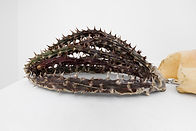
HELDEN, em seu quarto ato da série nomeada Réquiem, está deitada em uma base branca do tamanho de seu corpo, este vestido com uma roupa-pele de látex branco que cobre o corpo todo, com luvas e meias de látex com espinhos de metal, de material translúcido e aspecto leitoso, enquanto um som de sinos marca badaladas regulares e ressoam pelo ambiente através de caixas de som. Em sua cabeça está posicionada uma coroa em formato de capacete feita de espinhos naturais (planta conhecida como espinheira santa) em cima do rosto, enquanto um gelo de doze quilos, içado por cabos de aço e apoiado por uma grelha metálica, derrete lentamente sob seu corpo, que resiste ao frio congelante pelas próximas quatro horas.
MOTA, performando “specculum/puella", existe em três corpos: bonecas mascaradas encenam movimentos lentos ao som de música clássica tocada por pianos, saindo de caixas de som. Duas estão no chão, sentadas, e uma senta sobre uma cadeira do tipo divã ao centro, hora escrevendo em uma máquina de escrever, hora posando de costas. Os gestos de todas são delicados e calmos seguindo a música. Vestem colãs brancas que cobram corpo todo, incluindo mãos e pés. Usam máscaras inspiradas em personagens de anime japonês, perucas loiras e longas, roupas de renda delicadas e curtas sobre o suit. Estão posicionadas sobre tecidos, onde estão elementos como velas falsas e partituras. Se movem fora de sincronia, de maneira complementar, durante o período de quatro horas.
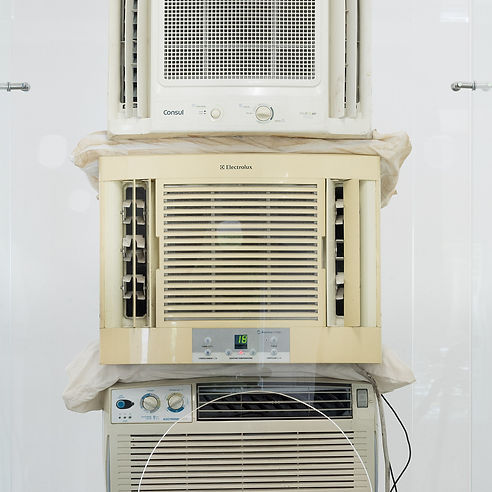
TEPEDINO, performa “zéfiro", mas não em pessoa. A escolha do artista é representar o corpo que performa com uma instalação de ares condicionados, cinco no total, empilhados em cima uns dos outros, separados por travesseiros sujos. Esses ares estão ligados e funcionando dentro de uma caixa de vidro com saída pequena para o ar na parte da frente. Os ares respiram e transpiram, aquecem e resfriam dentro desse vidro numa performance que dura quatro horas.
Marina Leite
superaquecido. superexplorado. cansado. fatigado. à mercê da falha
coração - oxigenação - átrio - sístole - diástole - antígona - performance - ato
abandono da casca - saida - agua em movimento - água como agente performático
desfiguração, não-movimento, tentativa, repetição até a falha, não possibilidade da falha, superaquecimento, exaustão, trabalho, dano, liquidez, entrega, purgação, desafio, farpa,
locus, átrio, hall, receptáculo, cerâmica, corpo, jarro.
And for Us, All That Remains Is Fur and Bones
Within us, scrap.
Let us think of performance as the action of a body. And the body must be there. The body, too, is expected to be an infinite number of things. Within contemporary art, we associate movement and stillness with performance, and the body longs to present something, represent something, reveal, point, and tell. The body also longs for an infinite number of things.
Our body, an insistent machine, is capable of revealing so much through its programmed mechanisms and obsessive functioning, unfolding and unfolding until it dissolves into a place I understand as immaterial—the place of non-vision.
The thoughts that inhabit this territory are almost metaphysical: Does feeling reside—physiologically—within us? Where does desire dwell? Fatigue? Are they systemic, or do they accumulate somewhere in our joints? Is the spirit of the body inside us, clinging to our organs, to the right of the left ventricle, or does it hang invisibly from the wings of our shoulders?
As the director and founder of Projeto Caroço, for the past three years I have sought to align myself with artists and curators who give shape to the hunger of the bottomless stomach I feel as I feed from the plate—the leftovers—of Brazilian contemporary art. I write whenever I can, even when I probably shouldn't, and I organize my observations about what we propose as the program of a project that moves with slow and curious steps within a market that already knows exactly what it wants.
The exhibition occupying the space in March, AAATRIOOO, announces, in its very title, its first visual repetition—that of the vowel—insistent and contagious like a yawn, inviting us to gather for an evening of four durational performances unfolding simultaneously throughout the gallery, each lasting four hours, with two taking place on each floor. The proposal, born from a conversation between the artist Aun Helden and myself, seeks to create a space receptive to the performative event, arriving before the audience like blood entering the atrium of the heart, distributing experiences to the senses that range from physical interaction—as in EYIBRA's performance, which asks, TOUCH ME AS IF MY BODY WERE YOUR PROPERTY, performed from the context of a Mexican body existing and resisting borders that do not want it alive—to Raphael Tepedino's body-machine, who chose a mechanical installation to represent the being expected to deliver effort and labor through performance.
Ascending to the second floor, the artist Lau Mota, through a performative installation, invites us into a house of puppets—the depersonalization of the masked body, the person occupying the place of the object, and a setting charged with a triadic logic acting in unison, while suggesting a strange and compelling image. Finally, we arrive at Aun Helden's presentation, oscillating between dying and living beneath the slow melting of the ice-body suspended above her.
Lau Mota's practice frequently provokes the disintegration of individual identity, whether through the incorporation of masks or the creation of replicas of themself that relate to one another, though never directly. The artist creates an atmosphere in which the interplay of elements within the installation gives rise to a scene that feels uncanny to the viewer. This speaks directly to the concept of depersonalization as an active form of resistance against the demands imposed upon the body by contemporary systems. The puppets and masks create a kind of "void" within the body—a body that no longer recognizes itself. In specculum/puella, the bodies seem unable to recognize one another or even possess a sense of individuality; they observe themselves and the audience with calm, measured innocence, at times interacting with their reflection in a mirror, at others appearing surprised by the texture of their fabric skin.
In an age defined by relentless productivity and constant output, Mota's bodies reject individuality, multiplying into versions of the self—objects that question the very notion of the body as a tool of efficiency, while simultaneously surrendering themselves to the gaze that watches and disciplines. The mask thus becomes a symbol of this alienation, but also of the possibility of resisting the dominance of the "self"—a refusal to be consumed by the norms of a system that dictates who you should be and how you should act, while remaining subject to the control of observation and the depersonalization imposed by contemporary society, reducing the individual to a passive object.
Understanding Skin Value, by the artist EYIBRA, through its cry—TOUCH ME AS IF MY BODY WERE YOUR PROPERTY—the performance can be seen as an explicit act of resistance against the objectification of the body. By placing this sentence on the wall beside their own body, the artist directly challenges both the autonomy of that body and the ways in which it is consumed by the external gaze, whether through the American patriarchal system imposed upon Latin American countries or through political and social borders. The work brings to the foreground the struggle against the dehumanization of the body, a concern that also resonates in Lau Mota's practice and connects us to the pressures of performance placed upon bodies in contemporary society.
Helden's work in this act—Requiem No. 4—continues an auspicious line of research into icons capable of expressing the curiosity that drives her performative "agent-self." It is precisely in this space of resistance that her body, wholly concentrated on surviving exposure to freezing temperatures, emerges as a body in suffering, as though its organic matter refused to be contained by the rigidity of an imposed model. It is a body that, in surrendering itself to discomfort, stages one of the central demands of contemporary life: to be efficient, productive, unbreakable, until the body can no longer bend, until it overheats. Yet it is also a body that cools and warms, trembles at the slightest touch, grows mold, and remains alive.
The failure revealed in the performance is not merely an error or a rupture, but an undeniable state of resistance—the body undoing itself, decomposing, in an epic refusal of the relentless authority of time and of the very act of performing. Here we are reminded of the pointed critique that also emerges in Tepedino's installation, where the machine—the air conditioner responsible for maintaining a controlled environment—becomes a metaphor for relentless physical effort, for obsession with action, participation, and the routines of everyday life. Like Helden's body, the body in Tepedino's work is subjected to external pressure, repeating itself, functioning without rest, immersed in the heat generated by the demand for productivity until it can no longer sustain itself. The machine, serving as an extension of the body—or as a substitute for labor—insists on operating without pause, and with every cycle, the body embedded within it appears to yield, exhaust itself, becoming a reflection of the demands of a capitalist machine that never slows down.
The body in these performances is therefore more than a physical locus; it is a battlefield where surveillance—whether internal or external—marks every movement, every breath, every gesture. It is disciplined, shaped according to the norms of a system that leaves no room for failure, and through this endless cycle of repetition it is molded until it becomes an extension of the very logic of productivity and efficiency. As neoliberal society demands, the body must always remain in motion, always functioning, even when the weight of these demands pushes it toward burnout.
Yet the failure that emerges from these bodies is not simply collapse, but the body's final, exhausted act of resistance. A quiet yet powerful resistance against the processes of subjectification that seek to impose social and political norms and expectations, transforming the body into something controlled and predictable. In this sense, failure—the mistake the body can no longer avoid—becomes a necessary rupture, a break from discipline, a refusal of the performance imposed upon us. The body, fatigued and transformed, resists through its own failure, and in resisting, questions the very structures that attempt to confine it.
Performance creates the space that receives performance. The atrium, the great gathering hall, brings together four performers with distinct artistic practices that converge within a shared cavity of themes encompassing life, death, and human drives, ultimately meeting at a singular yet multifaceted point, like the facets of a diamond.
It feels deeply contemporary that we are asked to divide our attention between our own interests and a world saturated with information, while remaining immersed—submerged—in a system of constant service and relentless demands that overheats and cools our bodies in equally unhealthy ways. For this reason, the proposal was to resist before an audience that would necessarily have to miss something in order to experience everything. Four hours, four performances translating the anxieties of a generation for an audience unable to escape the fullness of our own realities. In the end—and also at the beginning—everything is embryonic.
And for us, all that remains is fur and bones.
HELDEN, in the fourth act of the series titled Requiem, lies on a white platform the size of her body. She wears a white latex second skin that covers her entire body, along with latex gloves and socks embedded with metal spikes. The translucent, milky material envelops her as the sound of bells marks steady chimes that resonate throughout the space. Resting on her head is a crown-like helmet made of natural thorns (from the plant known as espinheira-santa), covering her face, while a twelve-kilogram block of ice, suspended by steel cables and supported by a metal grate, slowly melts beneath her body, which endures the freezing cold for the next four hours.
MOTA, performing specculum/puella, exists through three bodies. Masked dolls enact slow movements to the sound of classical piano music played through speakers. Two sit on the floor, while the third sits on a chaise longue at the center of the space, at times typing on a typewriter, at others posing with its back turned. Their gestures are delicate and calm, following the rhythm of the music. They wear white bodysuits covering their entire bodies, including hands and feet. Their masks are inspired by Japanese anime characters, paired with long blonde wigs and short, delicate lace garments worn over the suits. They are positioned on pieces of fabric alongside elements such as artificial candles and sheet music. Throughout the four-hour performance, they move asynchronously, in complementary ways.
TEPEDINO performs zéfiro, though not in person. Instead, the artist represents the performing body through an installation of five air conditioners stacked one on top of another, separated by worn pillows. The units remain switched on inside a glass enclosure with a small opening at the front through which air escapes. The air conditioners breathe and perspire, heat and cool within the glass in a performance lasting four hours.
Marina Leite
overheated. overworked. tired. exhausted. at the mercy of failure.
heart – oxygenation – atrium – systole – diastole – Antigone – performance – act
abandoning the shell – exit – moving water – water as a performative agent
disfiguration, stillness, attempt, repetition until failure, the impossibility of failure, overheating, exhaustion, labor, damage, liquidity, surrender, purging, challenge, splinter
locus, atrium, hall, receptacle, ceramics, body, vessel.